
People are always asking me how to become more resilient.
Actually, they’re not. They’re usually asking things like, “Where’s the restroom?” or, “Could this meeting have been an email?” But every now and then someone asks, “How can I become more resilient?” The answer is surprisingly simple: stop expecting life to cooperate. Mike Tyson supposedly said, “Everybody has a plan until they get punched in the mouth.” That’s true unless you work in corporate America, where everybody has a strategic plan until someone sends an email marked URGENT!!! at 4:57 on Friday afternoon. Resilience isn’t about avoiding the punch. It’s about remembering which direction is up after your head stops spinning.
For years, psychologists argued over whether resilience is something we’re born with or something we develop. The latest research has finally settled the debate with a thoroughly satisfying answer: both. Some people seem to begin life with natural advantages, but resilience is also a skill that can be strengthened through practice. Since 2015, researchers have examined hundreds of studies, peered into brains with MRI machines, and discovered that resilience programs really do work. Techniques like cognitive behavioral therapy, mindfulness, and emotional regulation help people recover from setbacks faster and make better decisions under pressure. Scientists have even identified brain regions responsible for judgment, emotional control, and adaptation. Apparently, your brain comes equipped with a resilience department. Many of us simply forget to send anyone there.
Long before neuroscientists started producing colorful pictures of people’s brains, I had the privilege of studying one of the most resilient groups imaginable: American prisoners of war held in North Vietnam. During my doctoral research—and later as part of a longitudinal study—I interviewed men who endured years of isolation, torture, uncertainty, and conditions specifically designed to destroy hope. Yet many returned home psychologically stronger than anyone expected. Not perfect. Not untouched. But remarkably resilient.
What surprised me most wasn’t their courage. It was their humor.
You might assume there wasn’t much to laugh about in a prison camp, and you’d be right. The humor wasn’t a reaction to funny circumstances. It was a deliberate strategy for surviving unbearable ones. The POWs joked, invented nicknames, exchanged sarcastic observations through the tap code, argued over imaginary restaurant menus, and mentally redesigned their hometowns. They laughed not because captivity was amusing but because humor reminded them who they had been before prison and who they intended to be afterward. Their captors could control their bodies, but they couldn’t control their identities.
Modern psychology finally has a name for what those prisoners instinctively understood. Humor interrupts victim thinking without denying reality. It creates psychological distance from suffering. It reminds us that our circumstances are not our identities. That’s a lesson many executives could benefit from after one disappointing quarterly report.
People often ask how they can become more resilient. The answer is that you build resilience before you need it. You can’t walk into a 7-Eleven during the worst week of your career and ask the cashier where they keep the six-pack of resilience. It isn’t next to the potato chips. Resilience works more like a retirement account. You make deposits long before you expect to need the money. Every challenge you work through, every disappointment you recover from, every difficult conversation you survive becomes another contribution. Then, when life delivers the inevitable punch, you have something to draw upon besides panic.
One of the most remarkable things I observed among the POWs was that humor wasn’t simply individual; it was communal. Their jokes became part of the culture of survival. They risked punishment simply to exchange humorous observations through coded taps on prison walls. Humor reinforced belonging. It reminded everyone they remained part of a brotherhood larger than their suffering. Today, organizations spend millions trying to build teamwork. The POWs managed it with sarcasm and impeccable timing.
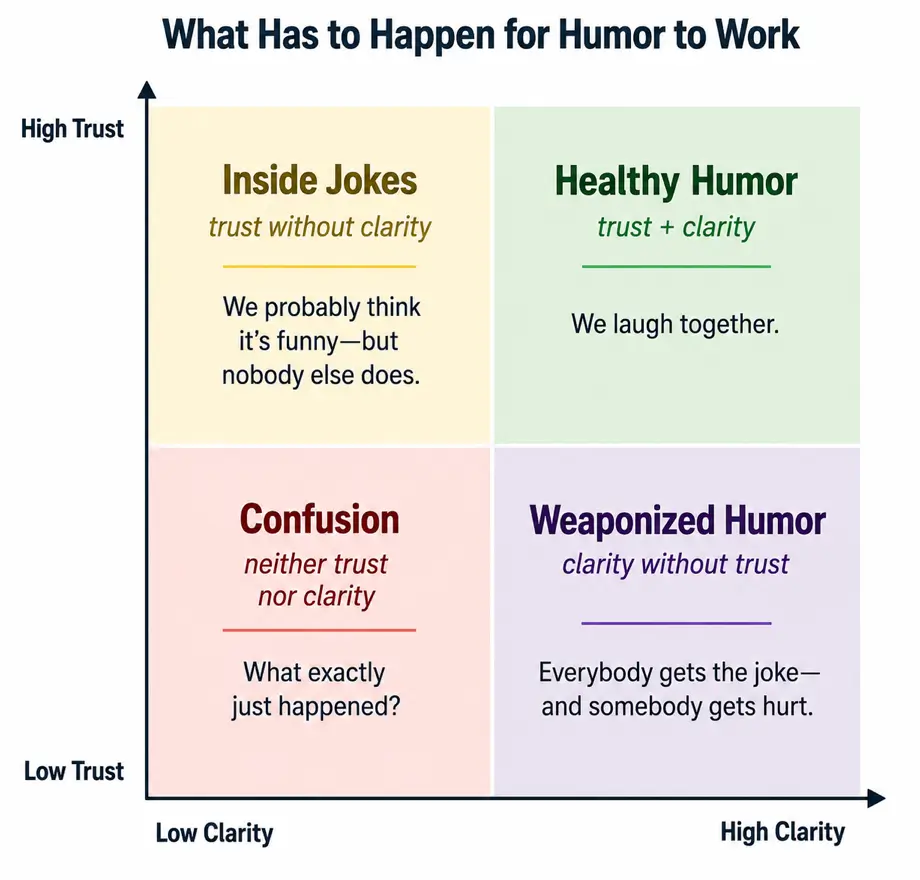
Of course, humor requires discernment. The prisoners never used humor to belittle one another or minimize genuine pain. They understood timing, audience, and purpose. Their humor united rather than divided. That’s why humor isn’t merely a personality trait; it’s a leadership skill. Great leaders don’t joke because they want applause. They use humor to stabilize emotions, restore perspective, and reconnect people with one another.
Perhaps the most powerful lesson involved failure. Even the strongest prisoners eventually broke under torture. That’s what torture is designed to do. Many returned to their fellow prisoners ashamed of what they had said or done. Yet the response they often received wasn’t condemnation. It was gentle humor, frequently initiated by the senior leaders themselves. The laughter wasn’t dismissive. It quietly communicated, “Welcome back. You’re still one of us.” Before anyone spoke about forgiveness, humor had already dissolved much of the shame. Today’s organizational psychologists call this reducing psychological threat. The POWs simply called it taking care of one another.
Humor also became their pressure valve. Long-term stress differs from crisis. A crisis is your building catching fire. Burnout is attending fourteen meetings about whether someone should replace the office coffee maker. The POWs couldn’t escape their circumstances, but they could create brief moments of shared absurdity that relieved emotional pressure without denying reality. Modern neuroscience now confirms what they demonstrated decades ago. Humor lowers stress hormones, improves emotional regulation, broadens perspective, and strengthens relationships. In other words, laughing is productive. Who knew?
The latest resilience research also reminds us there is no universal formula. What works for a fighter pilot won’t necessarily work for a kindergarten teacher, a surgeon, or an accountant in the middle of tax season. Different situations require different approaches. Yet one element appears consistently wherever resilient people thrive: meaningful human connection. Humor creates that connection faster than almost anything else.
People sometimes imagine resilience as standing heroically on a mountaintop while inspirational music swells in the background. In my experience, resilience looks more like someone saying, “Well, that didn’t go according to plan,” just before everyone starts laughing. The American prisoners of war I studied survived years of unimaginable hardship not because they denied reality, not because they never experienced fear, and certainly not because they possessed some magical resilience gene. They survived because they found purpose, supported one another, made disciplined decisions, and refused to surrender their sense of humor.
The scientists eventually proved that resilience can be learned. The POWs figured that out decades earlier. They simply didn’t need MRI machines to tell them. They already knew something every leader should remember.
If you can still laugh, despair hasn’t won.
Helping organizations and individuals achieve a more powerful success mindset.
Contact us to experience the dramatic growth and improvement.
Schedule a Call