
 In 1994, when I joined the Navy’s twenty-year follow-up study of the Vietnam prisoners of war and began interviewing former POWs, I expected to hear stories of courage, honor, and survival. What I didn’t expect was laughter.
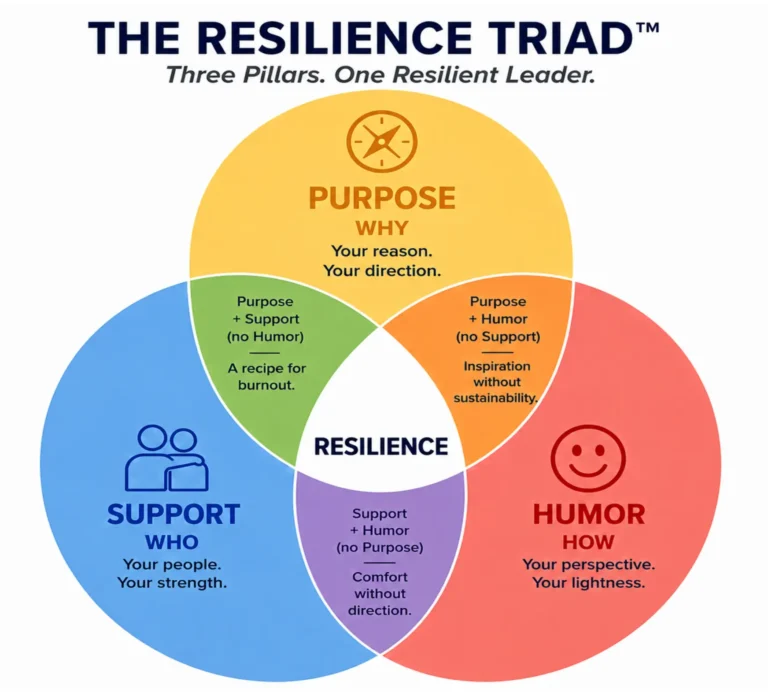
Men who had endured years of torture, isolation, and uncertainty repeatedly described moments of humor that helped them survive. Over time, I realized humor wasn’t simply a welcome distraction; it was one of resilience’s foundations. Along with purpose and support, it formed the three pillars that sustained them through years of captivity—and continue to sustain leaders facing adversity today.
As my research continued, another truth emerged. Discernment begins the journey. Resilience finishes it. Discernment determines not only what we decide but also how we endure. It filters the trivial so resilience can focus on the essential. It identifies what deserves our attention, conserves emotional energy, and supplies the clarity needed to persevere.
The Vietnam POWs understood this instinctively.
Captain James Stockdale and Colonel Robbie Risner could not eliminate torture, isolation, or uncertainty. They could not control the actions of their captors or dictate how every prisoner would respond. What they could control was their own example. They modeled courage, reinforced purpose, protected hope, and built a culture in which other prisoners could do the same. Their discernment showed itself in countless daily decisions. They knew:
- Which information to believe.
- Which values to protect.
- Which battles to fight.
- Which insults to ignore.
- Which hopes to preserve.
Because they refused to squander emotional energy on the uncontrollable, they retained the psychological strength to endure what they could not change. That same principle separates resilient executives from exhausted ones today. The resilient leader doesn’t react to every email, chase every crisis, or lose sleep over every criticism. Discernment distinguishes urgency from importance, signal from noise, symptoms from causes, and reversible decisions from irreversible ones. Those distinctions preserve the emotional resources resilience requires.
Recent Research
Scientists continue to learn more about why resilience works and have identified genetic factors that may influence how people respond to adversity. Studies consistently point to regions in the brain responsible for emotional control, judgment, and decision making. These discoveries help explain why some people recover from setbacks more quickly than others—and why resilience can be strengthened through deliberate practice.
The research also highlights an important caution. There is no universal formula for building resilience. Different people, organizations, and situations require diverse approaches. What works in a military unit may not be the best solution for a healthcare system or a corporate leadership team. Still, the overall message remains remarkably consistent. Resilience is not simply a personality trait that some people possess and others lack. It is a capability that leaders can cultivate in themselves and throughout their organizations.
That’s an important distinction. Organizations don’t become resilient because they hope for the best after a crisis. They become resilient because they prepare people to make sound decisions, adapt quickly, support one another, and continue performing well when circumstances become difficult. It also shows and adheres to the age-old aviator advice: Never run out of altitude, airspeed, and ideas at the same time:
Altitude (Purpose) answers:
Why should I keep going?
Airspeed (Support) answers:
Who helps me keep going?
Ideas (Humor) answers:
How do I keep this hardship from consuming me?
Post Traumatic Growth
Psychologists have debated the nature/nurture question for centuries—asking whether we come into this world with resilience as standard factory equipment, or we learn it along the way. The latest research suggests the answer is both. Genetics and temperament matter, but we can strengthen them deliberately.
Since 2015, resilience research has accelerated in two important directions. Researchers have asked whether resilience can be intentionally developed through training and explored what happens in the brain and body when people successfully adapt to adversity. They found the answer remarkably consistent. Large reviews of hundreds of studies show that thoughtfully designed resilience programs improve people’s ability to recover from setbacks and perform under pressure. Programs that combine cognitive behavioral techniques with mindfulness, emotional regulation, and purposeful reflection produce the strongest and most reliable results.
These findings did not surprise me. The men I interviewed had already known about them.
Only after I finished my work did psychology develop the language to describe what I had observed. In 1995, Richard Tedeschi and Lawrence Calhoun introduced the concept of “Post-Traumatic Growth” in Trauma and Transformation, proposing that profound adversity can produce meaningful psychological growth. The following year they introduced the “Posttraumatic Growth Inventory (PTGI),” giving researchers a standardized way to measure that growth. By the early 2000s, post-traumatic growth had become one of psychology’s most active areas of research.
The science validated what the Vietnam POWs had lived decades earlier: They did more than survive. They thrived.
The POWs experience also revealed something the research continues to confirm: growth does not emerge from adversity alone. Adversity merely provides the raw material. Growth begins with discernment—the ability to decide what deserves our attention and efforts. Resilience follows. Discernment determines the path. Resilience provides the strength to walk it.
Across resilience and PTG theories—including my own—the overlap proves striking. Those capable of posttraumatic advancement consistently do four things:
- They search for and discover purpose
- They hold a pragmatic view of reality
- They control themselves and as much of the situation as possible.
- They take their problems seriously and themselves lightly
Does resilience come from genetics or experience? While early theories emphasized hardiness traits, current research shows that resilience and PTG develop through practice and the development of psychological muscle.
Psychological muscle strengthens during calm periods, not chaos. Preparation determines performance. When people practice improvisation, they build instinctive response capacity. Muscle memory offers a metaphor. Once learned, riding a bike never disappears. Psychological muscles work the same way. Under pressure, trained instincts surface.
Psychologists refer to this capability as bricolage—the ability to improvise solutions using available resources. Musicians improvise. Survivors improvise. The POWs improvised, and successful leaders improvise. Bricoleurs do the following:
- Ask “What?” before “how?”
- Maintain global perspective
- Impose order during chaos
- Detect patterns early
- Prioritize relentlessly and consistently
Consequently, surprises—even unwelcome and complicated ones—don’t derail bricoleurs because experience triggers disciplined instinct. Resilient organizations overflow with bricoleurs. These companies don’t merely survive disruption; they exploit it.
Purpose Drives Performance
Meaning converts pressure into action. Resilience starts with meaning, but meaning doesn’t come from inspirational slogans. Meaning emerges through purpose under pressure.
Leaders who locate purpose during adversity stop asking, “Why did this happen?” and start asking, “What now demands action?” Leaders who fail at finding meaning default to victim narratives and blame market forces, talent shortages, and economic headwinds. Accurate observations, useless conclusions. Purpose converts adversity into movement. Without purpose, people freeze. With purpose, they act. Resilient organizations recover faster because they refuse to mourn what disappeared. They concentrate on what still matters.
The ability to find meaning during hardship forms the foundation of growth. People who find purpose during adversity rarely ask, “Why me?” They refuse to write a victim’s script and cast themselves as prey in a low-budget disaster film and develop a mindset lingers long after the loss.
When people doubt their ability to shape outcomes, they wait for rescue. They hope for luck. They surrender agency. Those who bounce forward refuse that posture. They act.
Jim Collins introduced the “Stockdale Paradox” in Good to Great. The leaders he studied accepted brutal facts without surrendering faith in the outcome. They confronted reality without pessimism and optimism without delusion.
The paradox takes its name from Admiral Jim Stockdale, who endured nearly eight years as a VPOW. He warned Collins never to confuse unwavering faith with avoidance of facts. Survival demands both. My original research shows that this faith saved him and the men in his chain of command in North Vietnam. In fact, we found less than 6% posttraumatic disorder (about average for a typical urban area) in the repatriated POWs.
Pragmatism determines business success the same way. Every organization succeeds—until it doesn’t. Too few leaders anticipate the moment when the model breaks. They hunker down. They wait. They hope disruption will pass.
It won’t.
Organizations that thrive during turbulence disrupt themselves before competitors do. They manage strategy decay as aggressively as product delivery. They accept that even brilliant strategies expire. Markets saturate. Competitors innovate. Unknown players rewrite rules, and they always have a plan “B.”
After crisis, yesterday’s strategy no longer applies. Leaders either design the next approach or cling to the old one and sink. A popular Gary Larson cartoon shows two dinosaurs watching Noah’s Ark sail away. One said, “Oh, crap—was that today?” Leaders who demonstrate a strong sense of purpose never miss the ark. They confront facts that matter to survival. They value optimism but reinforce it with contingency planning. Hope without preparation amounts to negligence.
Support
When we think of airspeed, we think of velocity and the forces that make us go forward. Countless studies indicate that getting the job done describes only part of the leader’s job; building relationships to keep the right people doing the job defines the other part of it. Relationships provide one of the main sources of fuel that helps successful executives accelerate their productivity and that of others.
Relationships, communication, closeness, and humor, all fuel us and provide the airspeed that keeps us going through adversity and enables us to help others. Communicating with those that we care about or who rely on us allows us to keep this perspective.
Our best support comes from those who love us, but during crisis most people turn inward instead of outward to the very people who can help them. The POWs couldn’t look to their families, but they had each other. In fact, with the threat of torture hanging over their heads, they created one of the most sophisticated communication systems in history for the sole purpose of raising the spirits of each other. It started with a tap code that evolved into sharing information, encouraging one another and telling jokes through concrete walls.
Few people volunteer for adversity, but high-performing leaders accept adversity as terrain rather than interruption. Resilience doesn’t eliminate pain. It eliminates paralysis. And often those around us can give us the kick in the pants that puts us on the right track. Trusted leaders must assume this role in the organization, but that won’t happen unless the leader has a support system outside the company.
Research on resilience and PTG consistently shows that people who turn toward others reverse the damage of destructive experiences more effectively than those who withdraw. Shifting identity from victim to rescuer restores mastery. Action replaces helplessness. Helping others fuels social support, which accelerates growth. People rewrite the chaos to prevent mental clutter from hijacking their energy. Selective perception doesn’t require denial. It encourages pragmatism.
If altitude provides perspective, airspeed delivers momentum. Momentum comes from relationships. Relationships come from communication, and humor comes from all three. George Vaillant M.D, one of the most influential psychiatrists and resilience researchers of the past half-century captured this perfectly: “Don’t think less of yourself—think of yourself less.” Leaders who inflate their own importance intensify crises. Leaders who maintain perspective shorten them.
Humor
The third building block of PTG involves humor—the willingness to take life seriously without taking oneself too seriously. Humor regulates stress. It restores agency. It builds cohesion. The VPOWs mastered this weapon. Though brutalized, they refused victimhood.
They controlled one thing absolutely: what they found funny. Decades after repatriation, psychological assessments of nearly 300 former prisoners show minimal PTSD. They created freedom where none existed. As one my study participants explained, “Under the worst conditions, we still laughed.” Humor signaled control. It reminded them each day that despair hadn’t won. The POWs used humor as a weapon against despair, isolation, and dehumanization. Laughter preserved humanity when circumstances threatened to erase it. Humor wasn’t denial. It was oxygen.
Humor doesn’t merely entertain; it reframes. It restores perspective, diffuses fear, and reinforces confidence. Leaders who employ humor under pressure communicate control. Leaders who can’t laugh telegraph overwhelm. Humor signals strength, not frivolity.
Humor surfaced because the men built psychological muscle before they needed it. The jokes, “hymns,” and antics among the aviators started with day one of training when instructors said things like these:
- “If you see a bomb technician running, keep up.”
- “Latitude marks where you’re lost. Longitude marks how long.”
- “There are bold pilots, and there are old pilots, but there are no old, bold pilots.”
Humor prevented psychological fragmentation. Shared laughter created survival systems rooted in connection and meaning.
We see the same phenomenon today. During COVID, people reclaimed control through humor—memes, jokes and, shared absurdity. Laughter didn’t deny danger; it denied helplessness.
Creative problem-solving captures one of the most essential talents a leader can possess. Leaders who can look at diverse information and see relationships, reason abstractly, make logical connections, and think of the future as open and malleable bring an invaluable asset to their organizations: the capacity to generate ideas. When leaders have ideas, they can solve unfamiliar problems and make decisions that are in the best interest of their direct reports and the organization.
Having ideas makes us mentally flexible, which in turns equips us to see things from several perspectives, tolerate ambiguity, adapt to change, and solve problems in new ways. When people don’t value flexibility, tragic things happen. Think of the tragedies of history. Look at the Greek tragedies, the Shakespearean tragedies, and the Sopranos—all tragic because people clung to inflexibility.
When Crisis Becomes a Competitive Advantage
To draw lessons from US history, one need look no further than the Cuban Missile Crisis, which was actually named a crisis at the time, to understand the importance of maintaining altitude, airspeed, and ideas. While contending with the civil rights movement at home and recovering from the botched attempt to overthrow Cuban dictator Fidel Castro in the Bay of Pigs invasion in April 1961, Kennedy faced the central crisis of his presidency—and perhaps of the entire cold war. In October of 1962 Khrushchev, emboldened by Kennedy’s failure at the Bay of Pigs, sent Russian ships carrying nuclear warheads to Cuba in an attempt to establish a Soviet nuclear presence just ninety miles off the coast of Florida.
Kennedy resisted calls for direct engagement and ordered, instead, a naval blockade around Cuba. The move prevented the Soviet ships from gaining entry to the island and bought time for cooler heads to prevail. On Oct. 22nd Kennedy declared that any missile launched from Cuba would warrant a full-scale retaliatory attack by the United States against the Soviet Union. On Oct. 24th Russian ships carrying missiles to Cuba turned back, and when Khrushchev agreed on Oct. 28th to withdraw the missiles and dismantle the missile sites, the crisis ended as suddenly as it had begun.
Even though the US faced a real threat of destruction, Kennedy did not lose his perspective. Presidential advisor, Ted Sorensen, would recall Kennedy insisted on knowing all his options. He did not do anything rash—did not panic or overreact. He was calm and never lost his sense of humor, perspective, or modesty.
Posttraumatic growth (PTG) describes the positive change some people experience through sustained struggles with crisis or trauma. This growth does more than restore equilibrium. It propels individuals to levels of functioning they would never have reached without adversity. Research now confirms what practitioners have long observed: humans don’t merely recover from trauma—they can leverage it. They don’t bounce back; they move forward.
Conclusion
Psychologists differ on the definition of resilience, but we share consensus on what resilience does not represent. It doesn’t signal sickness, pessimism, or failure to adapt. Nor does it guarantee growth. Some people return to baseline after trauma and stay there. Far fewer understand how to rebound and then outperform their former selves. That distinction raises the questions that matter most: Why do some people grow while others stagnate? And why do some leaders guide others through crisis while others freeze or flail?
Few people volunteer for adversity. Yet challenge—short of catastrophe—often produces growth rather than damage. When people develop coping skills during ordinary times, they face disruption with confidence and resolve. Herm Albright once quipped, “A positive attitude may not solve all your problems, but it will annoy enough people to make it worth the effort.” He had a point.
Helping organizations and individuals achieve a more powerful success mindset.
Contact us to experience the dramatic growth and improvement.
Schedule a Call